
MOQ can be zero — economic order quantity still matters
Get the Stone You Want at the Quantity That Makes Sense
We accept one-piece orders with no MOQ, and still give honest economic order quantity advice on slabs, blocks, packing and freight.
Why our MOQ can be zero, and why we still give EOQ advice
Buyers usually ask two things first: what is the minimum order? and how much should I order to make it worthwhile? At Apexstone our MOQ can be zero — we will take an order for a single piece. But we can make it is not the same as it is worth making. Here is why we can offer zero MOQ, why we still owe you honest economic-order-quantity advice, and how we help you buy what you genuinely love without paying for waste.
Every buyer is treated the same
Whether you run a long-term, full-container project or are contacting us for the first time as an individual, you receive the same standard, for two reasons. We like challenges. From the most ordinary item to an extremely complex piece that needs deep research and repeated prototyping, we push at the limits of advanced machinery to break the technical ceiling — as we did for the Sicilian Grey solid marble pedestal sink project, where 41 monolithic one-piece stone basins were CNC-carved and hand-finished in City of Industry, California.
We are driven by the beauty of natural stone. No one here is simply working to get by; we create with our hands out of a love of beauty, and share it with people who care about natural stone just as deeply. For more than twenty years we have shaped timeless spaces across six continents and over thirty countries — you can read more about us. Even when the order is a single piece, that is our MOQ-Zero.


Use the pre-order consultation first
Although we accept an order for even one piece, you still need to decide whether buying from our factory in China is economical and workable for you. Before you commit, make full use of the early consultation, even if you only have a rough, half-formed idea, so we can find the balance between what you truly love and what you are willing to spend.
Start with intent — the kind of space and style that fits your life. A small, highly individual feature or accent wall is one thing; the large floor and wall surfaces that set the whole environment are another. In a private bathroom you might plan a countertop, a freestanding bathtub, or the whole shower space together. For personalised work there are carvings and sculptures and the stone paths of an outdoor garden.
Start with the material — tell us exactly what you have in mind, or find your stone among more than two thousand options in the Stone Finder. And if it is only an idea in your head, our design team can carry it from concept to reality with concept design, 3D modelling and a true-to-life preview of the finished result.
The real cost, from raw block to unboxing
Beyond willingness and capability, there are four cost gates between raw stone and the moment you open the finished piece at home.
Slab-made products: the yield problem
Countertops, vanity tops and assembled pieces offer an almost unlimited choice of material, but the minimum is one full slab. Even when we hold stock or a remnant from another order, it may not be the stone you like or a size that fits, so a new slab is needed. A typical natural-stone slab is around 2.8 m by 1.8 m. If you cut only a 1.5 m dining table from it, the yield is just 44.6%, and you would have to buy the remainder because we cannot know when it might next be used. That is uneconomical, and the order quantity is poor.

Carved products: the whole-block problem
There is far less room here, because the work starts with buying a whole block: no one stocks material, without an order, for a shape not yet known. Only three high-volume stones, Carrara White, Indian Green and Nero Marquina, are kept ready, so bathtubs, solid stone sinks, furniture, lamp bases, vases and other carvings can be made at any time. Insisting on another stone and taking only part of a block is generally impractical: once a section is removed the block can no longer yield slabs, and cutting a local piece from a three-dimensional cube wastes a larger share than cutting from a flat slab — while a single block can be worth tens of thousands of dollars. What carries a one-off monolithic carving across the threshold is a project-scale quantity that makes full use of the block. A Sicilian Grey block is roughly 2.8 by 1.8 by 1.6 m and a basin about 0.97 by 0.65 by 0.48 m, so several basins come from one block; the 41 basins needed several blocks in total — see the pedestal sink case.

Packing: more fragile than glass
Natural stone, shaped by its veining and internal flaws, can be very weak in certain directions and is more easily damaged than the uniform, man-made material of glass. Quartz, silica-free stone and sintered stone behave more like glass. Stone packing takes more volume and adds considerable weight beyond the product itself.


Freight and duty
Unless a quote is clearly marked DDP — delivered, duty paid — the figures do not include destination-country duty.
Real freight costs, five countries and three methods
The detailed record, built from actual forwarder quotations across sea, air and express shipments, is in the PDF below. It shows how each method is charged: sea LCL prices a revenue ton that is the greater of volume and weight, with one-time fees added per bill; sea FCL is a flat rate per 20GP or 40HQ container; air and the international express carriers price a chargeable weight that is the greater of actual and volumetric weight.
The point that matters most for a small buyer is the set of one-time fees charged per bill — customs clearance, documentation, manifests, delivery orders and the like. They barely move with weight or volume, so a bill holding a single countertop carries the whole fixed fee, while a bill combining a countertop, pavers and carvings pays it only once, spread across the whole project. Combining product types is what turns a single category that cannot fill a container into a project that reaches an economic shipping volume.
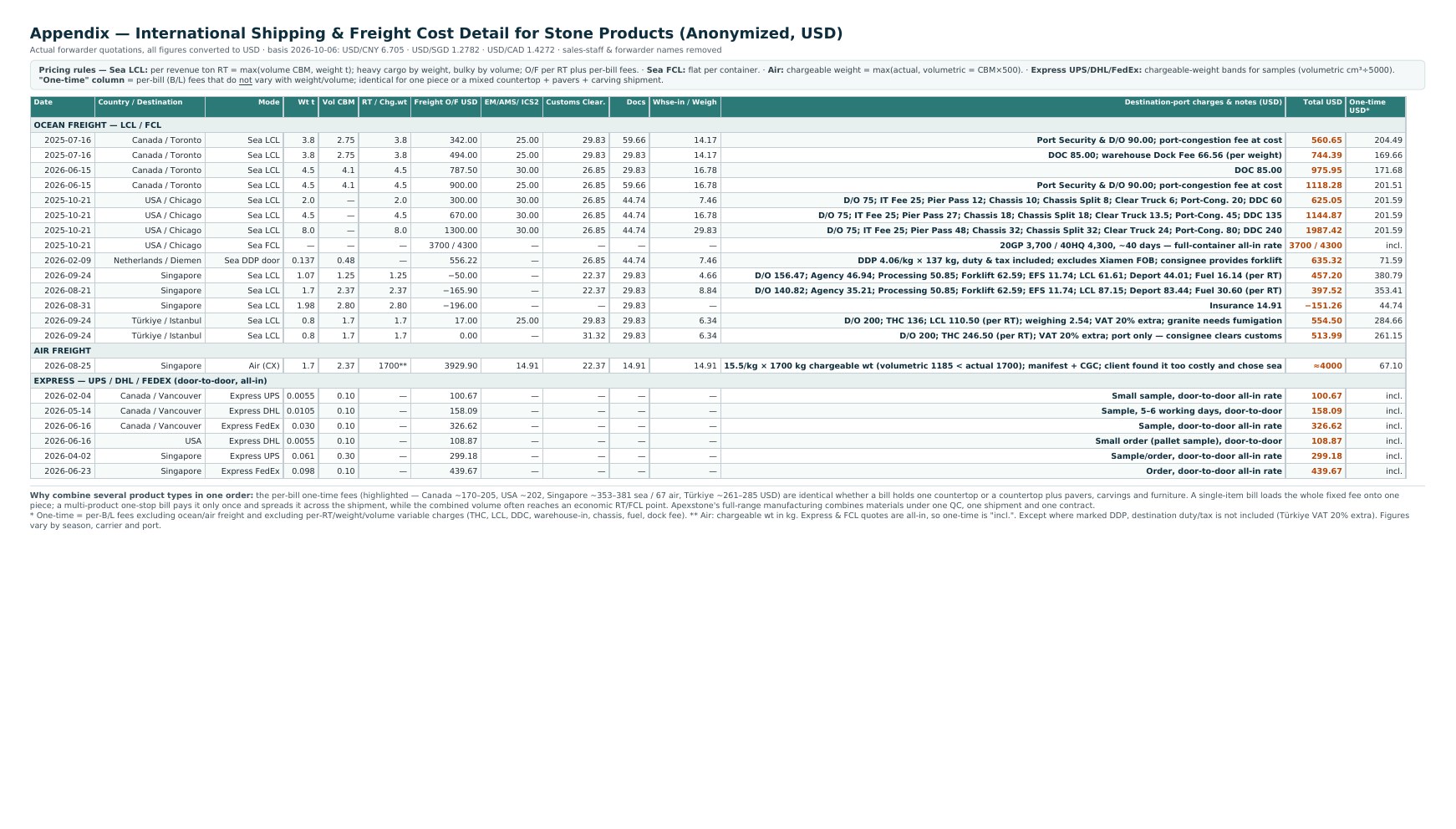
eoq-international-freight-costs.pdf — 21 itemised shipments, 14 by sea, one by air and six by express.
How we address economic order quantity
Use the whole slab — alongside a dining table, add smaller pieces such as a coffee or side table to raise the yield and cut waste. For carved forms, standard 2 cm slabs can be stacked and joined to read as a solid body on the main viewing faces, at a much lower cost and without the restrictions of buying a whole block. Plan the order around the one-time freight fees, so the fixed cost is paid once across several items rather than loaded onto one. And where duty works against one material, the breadth of our range lets us switch legitimately: the United States applies heavy anti-dumping duty on Chinese engineered quartz but ordinary duty on natural stone and glass stone, while Türkiye applies roughly USD 174 per tonne on Chinese granite yet ordinary duty on marble and quartz.
Closing

Although the MOQ is zero, a customer's truly economical order quantity still benefits from careful optimisation on our part. Through discussion we can put together combined solutions, so you really do get the product you want while making the order as economical as possible. contact us — get MOQ and EOQ figures for your project. request a stone sample — start with a physical sample.