
Porcelain pavers have become the fastest-growing hardscaping material in the US, Australian and UK markets. They combine the classic looks of bluestone, travertine, granite and timber with technical performance natural stone and concrete cannot match: zero sealing, near-zero water absorption, R12 anti-slip surfaces and colors that do not fade. This guide covers what vitrified porcelain paving is, how to choose between 20mm and 3cm porcelain pavers, which sizes and colors work where, how they are installed, and how to order factory direct.
What Are Porcelain Pavers?
Porcelain pavers — also called 20mm pavers, 2cm porcelain pavers or exterior porcelain pavers — are thick-format porcelain tiles engineered for outdoor use. They are pressed from refined kaolin clay and mineral powders under very high pressure, then kiln-fired above 1,200°C. The result is a fully vitrified, full-bodied slab whose color and texture run through the entire tile rather than sitting on a surface glaze.
Industry-standard material characteristics include:
- Water absorption below 0.5% — the threshold that defines vitrified porcelain. Water cannot penetrate, so freeze-thaw cycles cannot crack the tile.
- A dense, hard body — porcelain typically reaches 6–8 on the Mohs hardness scale, resisting abrasion from foot traffic, furniture legs and garden tools far better than ceramic or concrete.
- Textured R12-rated surfaces — most 20mm paving carries a structured matte finish that achieves an R12 slip-resistance rating, the accepted benchmark for exterior paving in wet conditions.
- Full-body (through-body) color — because the pigment runs through the slab, chips and scratches are barely visible.
Porcelain pavers vs indoor porcelain tiles
Standard indoor porcelain tiles are 8–11mm thick with smooth, often polished faces. Outdoor porcelain is roughly twice as thick (20mm is the norm), with a grippy textured surface and rectified edges designed for 3–5mm outdoor joints. It is the same porcelain technology, but engineered for weather, point loads and wet-foot traffic.
Porcelain pavers vs natural stone
Natural stone — bluestone, travertine, sandstone, limestone — is beautiful but porous. Most varieties require sealing every 1–3 years, absorb oil and pool chemicals, and can fade, flake or etch over time. Vitrified porcelain paving reproduces stone and wood visuals with high-definition printing while being essentially stain-proof, frost-proof and maintenance-free, with perfectly consistent calibers from tile to tile. For a full head-to-head, see our natural stone vs porcelain pavers comparison.
| Feature | Porcelain pavers | Natural stone | Concrete pavers |
|---|---|---|---|
| Water absorption | < 0.5% | Varies (often 1–6%) | 5–10%+ |
| Sealing required | Never | Every 1–3 years | Recommended |
| Wet slip resistance | R12 textured finish | Varies by stone | Poor when worn |
| UV / fade resistance | Excellent (inorganic pigments) | Good, but weathers | Fades over time |
| Stain, oil & salt resistance | Excellent | Moderate to poor | Poor |
| Color consistency tile to tile | Very high | Natural variation | Medium |
| Weight (20mm, approx.) | ~45–48 kg/m² | Often heavier | Similar/heavier |
Why Choose Porcelain Pavers for Your Outdoor Project?
True all-weather durability. With water absorption under 0.5%, porcelain does not absorb rainwater, so it cannot crack in freezing conditions. It shrugs off frost, snow, coastal salt air and intense summer heat — the reason it is specified from Minnesota winters to Queensland summers.
Color that stays put. The pigments are fired into the body at extremely high temperatures. UV exposure does not bleach them, so a patio laid today will look the same shade in ten years — no patina, no darkening, no bleached patches.
Stain-proof and chemical-resistant. BBQ grease, wine, leaf tannins, bird droppings, chlorine and de-icing salts sit on the surface and wipe or rinse away. This is especially valuable around pools and outdoor kitchens.
No sealing, minimal maintenance. There is no surface to seal, ever. Day-to-day care is a hose-down or occasional light pressure wash, instead of the lifetime sealing and stripping costs of stone.
Non-slip safety. The structured matte finish delivers non slip porcelain paving at R12 level — a genuine safety advantage on pool surrounds, steps and rainy-climate patios.
Lightweight and fast to install. At roughly 45 kg/m² for 20mm, porcelain is lighter than most stone of the same thickness. Tiles cut cleanly with a diamond-blade wet saw and can be dry-laid on sand, set on mortar, or raised on pedestals — no crane, no stone-specific rigging.
A design range stone cannot match. One production line delivers bluestone looks, travertine looks, granite looks (sesame white, sesame grey, sesame black), marble looks and realistic timber planks — all with identical installation and maintenance.
Thickness Guide: 20mm (2cm) vs 30mm (3cm)
Choosing thickness is really a question of traffic and installation method.
| Thickness | Best used for | Typical installation |
|---|---|---|
| 20mm / 2cm porcelain pavers | Patios, courtyards, pool decks, garden paths, roof terraces, balconies | Sand/gravel bed, mortar bed, or pedestals |
| 30mm / 3cm porcelain pavers | Driveways, parking areas, commercial plazas, heavy point loads | Compacted sub-base with sand/gravel (flexible) or reinforced mortar bed |
20mm paving is the worldwide default for pedestrian landscapes. It is thick enough to walk on when laid over sand, gravel or adjustable pedestals, and its light weight makes it the standard for rooftop decks and raised terraces where structural load matters.
For vehicles, industry practice calls for 30mm porcelain pavers — often searched as 3cm porcelain pavers — laid on a properly engineered sub-base. Porcelain driveway pavers in 30mm handle the flexing and point loads of car tires on flexible beds. Note that 20mm tiles can be used for very light, occasional vehicle traffic only when fully bonded to a reinforced concrete slab with a proper mortar bed; this should always be confirmed with your installer or engineer.
At Apexstone we produce exterior porcelain pavers in 12mm, 15mm, 18mm, 20mm and 25mm thicknesses, plus 18mm ventilated-facade / cladding tiles. The 20mm line is our best seller for patios and pool decks; for driveway and heavy-load projects, contact our team to discuss thick-format production and the correct specification for your market.
Sizes, Formats & Laying Patterns
Porcelain pavers are sold in metric production sizes with imperial equivalents:
- 24x24 porcelain pavers (600×600mm) — the classic square format. The paver 24x24 is the single most popular size for residential patios and paths: easy to carry, fast to lay, and perfectly proportioned for stone-look designs.
- 24x48 large format (600×1200mm) — the modern premium look. Fewer joints mean cleaner sightlines across a patio or pool surround; large slabs also make small areas feel bigger.
- 600×900mm — a mid-size rectangle that bridges squares and planks, popular in contemporary designs.
- 400×1200mm and 300×600mm planks — long, narrow formats used for wood effect porcelain paving and linear stone patterns.
Rectified (precision-cut) edges allow narrow 3–5mm grout joints, so the finished surface reads as one continuous slab with barely visible joints. Layout options include stack bond, running bond, herringbone and staggered plank patterns.
French pattern paving
French pattern paving (the Versailles pattern) is a timeless modular layout combining several tile sizes in one repeating module — traditionally laid in travertine or bluestone across courtyards and pool decks. Porcelain makes the pattern practical: you get the old-world European look with R12 grip, zero sealing and consistent tile thickness throughout the module. It is one of the most requested layouts for travertine porcelain pavers and cream/beige ranges.
Most Popular Colors & Finishes
All 14 paver colors are shown in the porcelain pavers color chart. The bestsellers break down as follows.
Light grey porcelain paving — Sesame Grey (G633 look)
Light grey is the safest, most versatile outdoor color, and our sesame-grey body — matching the classic G633 granite look — is the bestseller across all three markets. Light grey porcelain paving hides dust and joint lines, reads cool and contemporary, and pairs with everything: white weatherboards, charcoal fences, timber screens, lush planting.
White porcelain paving — Sesame White (G603 look)
White and near-white pavers brighten shaded courtyards and north-facing gardens, and they stay noticeably cooler under bare feet in full sun — a real benefit poolside. Our sesame-white body reproduces the fine salt-and-pepper grain of G603 granite. White porcelain paving is the top pick for coastal homes, Hamptons-style exteriors and minimalist designs where the hardscape should visually recede.
Black porcelain paving — Sesame Black G654, Fuding Black & China Black
Black pavers create drama: a dark pool surround makes water look deeper, and dark paths frame green planting like a picture mount. We offer several black bodies — sesame black (G654 look, fine dark grain), deep Fuding Black and China Black, plus a Black Galaxy option with subtle gold flecks. Bear in mind that black porcelain paving shows dust and pollen more readily and gets hotter in direct sun, so it is best used in shaded areas, around water, or as accent bands and borders.
Cream & beige porcelain paving — Rusty Yellow G682 look
Warm cream, sand and soft golden tones deliver the Mediterranean, Tuscan or travertine-country look without travertine's maintenance. Our rusty-yellow (G682 look) body blends beige with faint golden-brown mottling. Cream/beige porcelain paving hides sand, soil and pet hair, complements stone-clad houses and terracotta details, and is the classic base for French pattern layouts.
Bluestone look porcelain pavers
Bluestone is the heritage paving stone of the US Northeast and much of Australia — but real bluestone can flake, require sealing and heat up. Bluestone porcelain pavers reproduce the characteristic blue-grey tones, natural cleft texture and subtle variation while offering R12 grip, frost resistance and zero sealing. It is the most common upgrade choice for buyers who love the bluestone look but want porcelain performance.
Wood look porcelain paving
Timber decking rots, splinters, needs annual oiling and becomes slippery when wet. Wood-look porcelain — including our sandalwood-toned plank — gives you realistic grain in 400×1200mm or 300×600mm planks that never warp, never splinter, and need nothing but a rinse. Wood effect porcelain paving works beautifully on garden paths, around hot tubs, and on roof terraces where timber cannot be used.
Travertine look porcelain pavers
Travertine is the stone of pool decks and French patios — but it etches with pool chemicals and must be sealed. Travertine porcelain pavers (including our white travertine body) capture the warm veining and filled-pore texture, stay unaffected by chlorine and salt, and arrive in consistent calibers ideal for french pattern paving. They are the first choice for resort-style pools and classical courtyard designs.
Beyond these core ranges, the line also includes Carrara White marble look, golden-hued granite looks and Maple Red for accent bands and feature areas.
Where to Use Porcelain Pavers
Porcelain pavers for patio
The patio is where 20mm porcelain shines. Porcelain pavers for patio use handle BBQ grease, moved furniture, UV exposure and freeze-thaw without fading or staining. Choose 24x24 squares for classic courtyards, 600×1200 large formats for a clean modern slab with almost no visible joints, or French pattern for a traditional estate look. Light grey and cream tones are the most popular; wood-look planks suit covered outdoor rooms.
Porcelain pavers: pool deck and porcelain pool coping
A pool surround demands three things: slip resistance when wet, resistance to chlorine and salt, and a surface that stays comfortable underfoot. Porcelain delivers all three: R12 textured faces, a fully vitrified body that pool chemicals cannot penetrate, and light colors that reflect heat. Porcelain pavers pool deck projects typically pair 24x24 or 600×1200 deck tiles with matching porcelain pool coping — purpose-finished porcelain pool coping tiles with bullnose (rounded) edges that give the pool rim a clean, safe, finished profile in the same color and batch as the deck.
Porcelain driveway pavers
Driveways need thickness and a proper sub-base. Specify 30mm porcelain pavers for vehicular areas laid on a compacted base with sand or gravel joints, or a full reinforced mortar bed. 20mm material is not recommended for routine vehicle traffic unless fully bonded to reinforced concrete. Porcelain driveway pavers bring the same fade-proof, oil-resistant, easy-clean surface to the front of the house — and oil drips rinse right off, which concrete and stone cannot claim.
Porcelain garden paving
Paths, stepping-stone routes and garden terraces suit the full range: 300×600 planks for winding woodland walks, 24x24 squares for utility areas, and wood-look planks that wind through planting without rot risk. Porcelain garden paving also works over pedestals on garage roofs and basement gardens, where weight and drainage are constraints.
Installation & Maintenance
There are three established installation methods:
- Dry laying on sand or gravel — a compacted sub-base, a bedding layer of sand or fine gravel, and permeable joints. Fast, DIY-friendly, fully drainable, and easy to lift or relay. Standard for 20mm pedestrian projects.
- Mortar / adhesive bed on concrete — tiles are bonded to a concrete slab with exterior-grade adhesive and pointed with mortar. The most rigid method; required for heavy loads and the recommended approach when 20mm tiles are used in light-traffic vehicle areas.
- Raised pedestal system — adjustable plastic pedestals support the tiles above a waterproof membrane, creating a ventilated void for drainage and cables. The standard for roof terraces, balconies and podium decks.
Tiles are cut with a diamond-blade wet saw; because the body is full-color, cut edges blend naturally. Pool coping uses dedicated bullnose pieces; step treads and edge trims are available to match.
Maintenance is minimal by design:
- Rinse with water or use a light pressure washer as needed.
- No sealing, no waxing, no re-finishing — ever.
- Stubborn marks lift with a mild household detergent; the vitrified surface will not absorb them.
- Avoid metal shovels on frozen surfaces (they can scratch the finish); plastic or rubber edges are fine.
Buying Factory Direct: Advice for Wholesalers, Contractors & Homeowners
As a Fujian-based manufacturer selling direct, here is how to buy smart:
- Specify five things when you request a quote: color/body name, tile size, thickness, surface finish, and quantity in square meters (add 5–10% for cuts and waste). Your destination port lets us price landed cost.
- Order samples first. Screens never reproduce texture and tone accurately. Sample pieces let you check the R12 surface underfoot, compare colors in your own light, and sign off before a container ships.
- Mix and match by container. 20mm pavers ship palletized and containerized; wholesalers and contractors commonly combine multiple colors, sizes and coping pieces — e.g., 24x24 light grey deck tiles with matching bullnose coping — in one 20ft or 40ft load.
- Match batches. Porcelain is consistent, but ordering the full project quantity in one production run guarantees identical tone. We plan batch numbers for phased projects.
- Ask about the full system. Pedestals, coping, step pieces, facade tiles (18mm ventilated cladding — see our porcelain wall cladding) and complementary colors can all be coordinated from one supplier.
Apexstone manufactures vitrified porcelain pavers in 12/15/18/20/25mm thicknesses across 600×1200, 600×900, 600×600, 400×1200 and 300×600mm formats — including sesame white, sesame grey, sesame black, Fuding black, rusty yellow, China black, black galaxy, Carrara white, white travertine and sandalwood wood-look bodies. We ship single samples for a backyard patio and full container programs for distribution alike. contact our team for factory-direct pricing and specification support.
Third-Party Slip-Resistance Tests — SGS R11 & R12
Our porcelain pavers meet the R11 slip-resistance standard, with selected products achieving the higher R12 rating. Both are independently verified against DIN EN 16165:2023-02, Annex B (shod ramp test), by SGS.
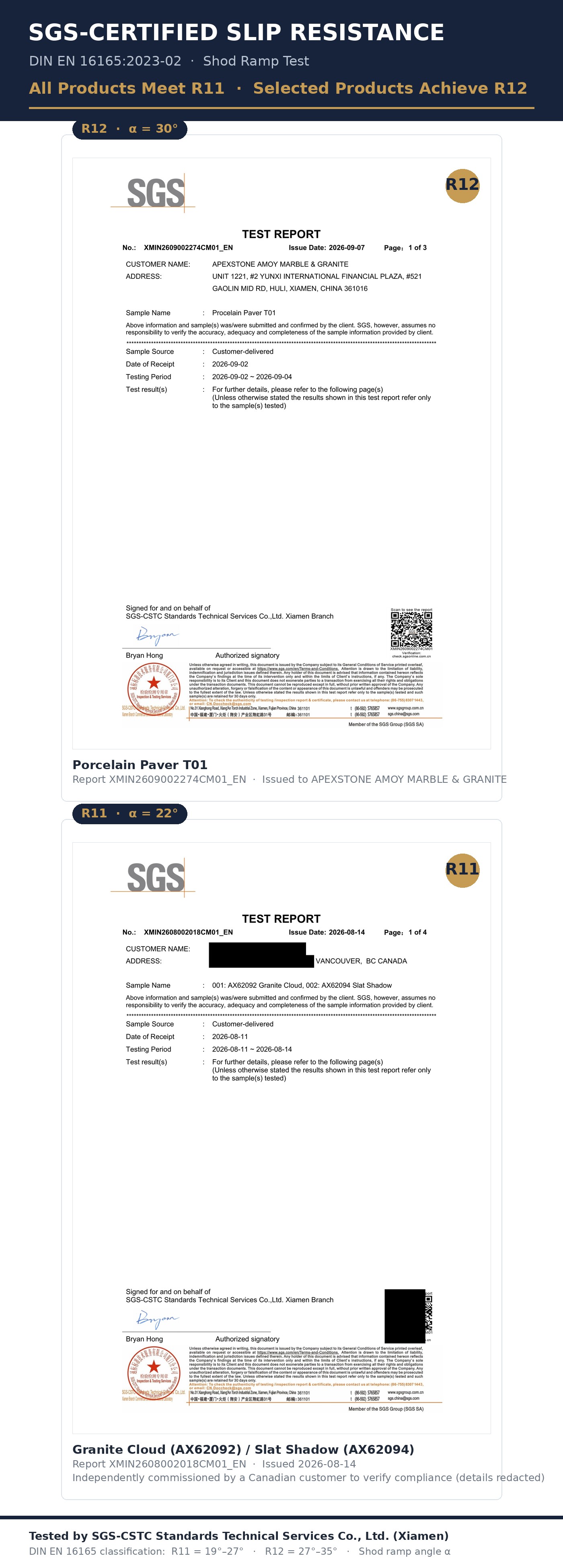
Porcelain Paver T01 — slip resistance class R12 (shod ramp angle α = 30°), SGS report XMIN2609002274CM01_EN, issued 2026-09-07.
Granite Cloud (AX62092) and Slat Shadow (AX62094) finishes — slip resistance class R11 (α = 22°), SGS report XMIN2608002018CM01_EN, issued 2026-08-14.
The R11 test was independently commissioned by a Canadian customer to additionally verify that the products meet the required standard; customer-identifying details have been redacted.